
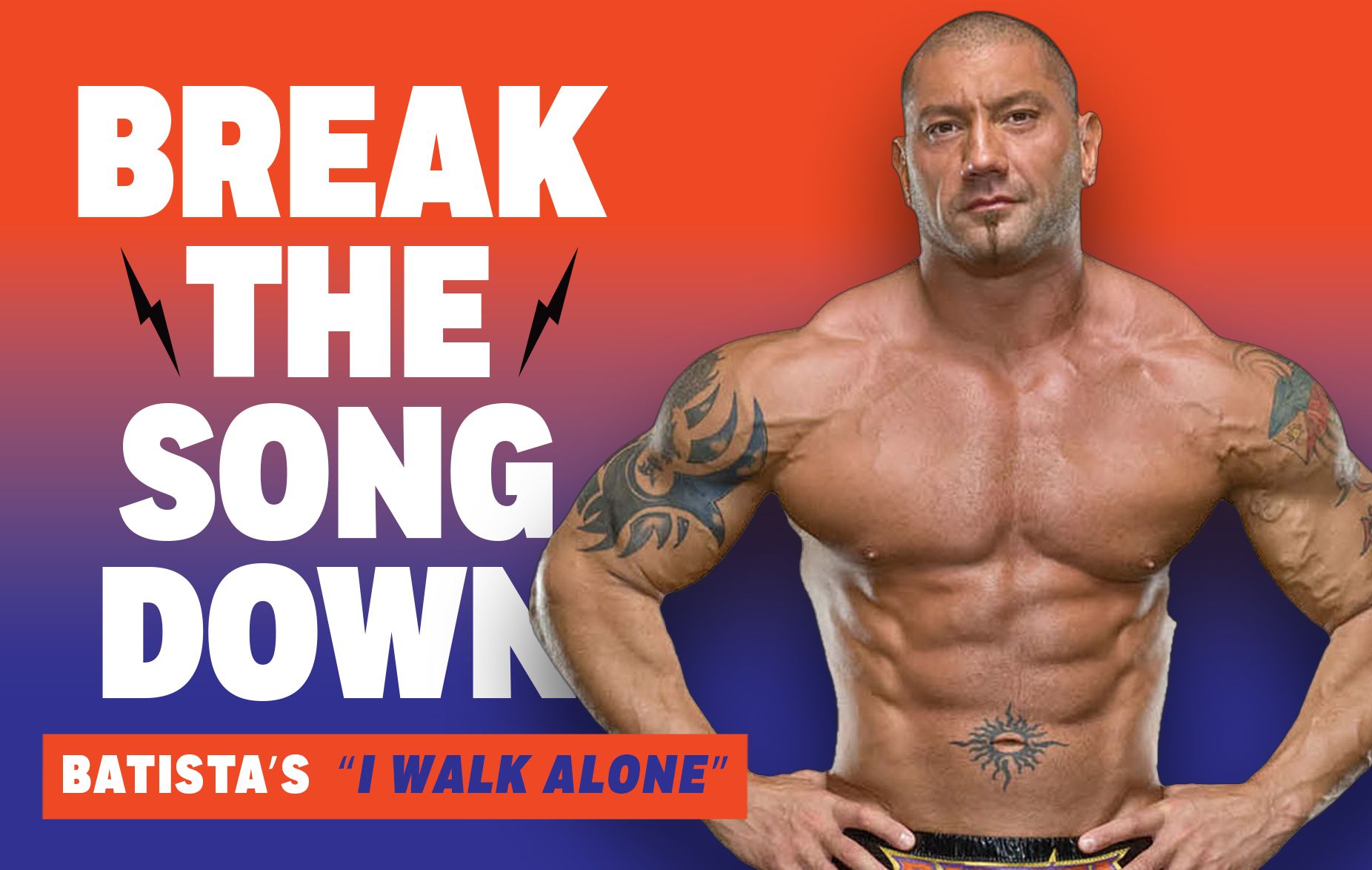
Music has been an intrinsic part of professional wrestling. In Break The Song Down, we revisit the music that has echoed throughout the squared circle, from the five-star classics to underrated gems.
Life is funny. If I were to say we’re discussing a male wrestler who debuted in the first half of 2002 with a dead-in-the-water gimmick, underwent a life-changing rebrand the following year, won their first world title at WrestleMania 21 (after being involved in the botched finish of the 2005 Royal Rumble), became a featured star of the “Ruthless Aggression” era before seeking fame in Hollywood, and whose successful movie career is (currently) defined by a semi-comedic role in a superhero movie franchise helmed by James Gunn….you’d have to ask, “which one?”
…and I would say, “the one with the butt rock theme song.”
Dave Bautista arrived when the WWE was in a transitional period. Literally: just three days before he debuted on the May 9, 2002, episode of SmackDown!, the fed rebranded due to a lawsuit by the World Wildlife Fund.
From WWF to WWE. “Get The F Out” became a rallying cry, most memorably when The Rock lambasted “Stone Cold” Steve Austin, breaking kayfabe on the June 17, 2002, episode of Raw, a week after Austin no-showed to avoid losing to rookie sensation, Brock Lesnar.
This was just the tip of the Sturm und Drang going on at the time. Dave, now known as Batista, walked into a WWE that had vanquished all its foes, burned through its goodwill (thank you, Invasion storyline) and was experimenting with brand splits and brand new wrestlers.
The wave of the Attitude Era had crested and was rolling back by 2002, and Vince McMahon knew it. Austin’s walkout forced him to reconcile that he needed new stars in the pipeline, so he delivered his “ruthless aggression” promo during a June 2002 episode of Raw, imploring Superstars to step up.
Some did, like two new names on the roster: Batista and John Cena.
Both men debuted in 2002 with dumb gimmicks: Cena wore the town’s sports colors to widespread apathy; the silent Deacon Batista accompanied Reverend D-Von and did nothing of note. But by November of that year, things had changed. Cena was deep in his breakthrough “Doctor of Thuganomics” role. And Batista had ditched his Deaconship, freeing him up to join Triple H’s Evolution in 2003. Lives and the WWE were changed.
As the company navigated the waters beyond the Attitude Era, Cena and Batista built up a following. The crowd got behind them. They wanted to see these two win. And they did: both claimed a world title at WrestleMania 21 in 2005.
That year, Cena had debuted his now iconic theme, “The Time Is Now.” It’s also the year that Batista decided it was time for him to walk alone.
The Song: “I Walk Alone” by Saliva
Saliva was thick in the “butt rock” pack of the early 2000s—when radio stations promised to play “nothing but rock.” It was similar to nu metal in some ways. Downtuned guitars. Singers who rapped (often poorly) as much as they sang. But it was more about partying and living it up than being sad or worrying about social issues.
Take, for example, Saliva’s video for their first major single, “Your Disease.” Vocalist Josey Scott looks like a pair of Dave Navarro’s leather pants made a wish to be a real boy. Scott raps the verses and sings the choruses while behind the wheel of a muscle car. The video’s colors are muted in a filter that makes everything seem gray and greasy until the end. It’s the epitome of Y2k rock.
While Saliva wasn’t as commercially successful as some of their counterparts — they never went to No. 1 like Creed or Nickelback — they left their mark on pop culture by being all over the “Ruthless Aggression” era.
“I think our music goes hand-in-hand with the drama of WWE,” Scott said in a 2009 post on WWE.com, announcing that the band’s “Hunt You Down” would be the theme of that year’s No Way Out pay-per-view.
And so, when it came time to re-record Batista’s theme, the WWE called up Josey and crew. It was a match made in oversized JNCOs. In a behind-the-scenes vignette on the making of Batista’s theme, composer Jim Johnston remarked it was “one of the smoothest [collabs] that ever happened. They just did a great job right out of the box, with no tweaking, no drama.”
Breaking It Down:
https://x.com/FadeAwayMedia/status/1981395271771926747
“I Walk Alone” builds on Batista’s first solo theme, “Animal.” It’s a 2000s Jim Johnston Jam in the fullest sense: fuzzed out power chords; a whining sustained guitar note that leads into a weedly-weedly-wee six-string strut. More power chords. A solo no one ever hears. Fade out.
Saliva didn’t really deviate from Johnson’s composition to the point where Jim got a writing credit on “I Walk Alone.” I wish they did.
Because it sounds like Johnston built “Animal” from extra parts he had lying around the studio, twenty minutes before turning it in. Sorry, Jim. I hear the same plodding tempo and chugging guitars found on an Undertaker or Kane theme. That siren guitar solo is like the whine from the bridge of Triple H’s “The Game” (which, I know, Motorhead wrote it, but the point stands).
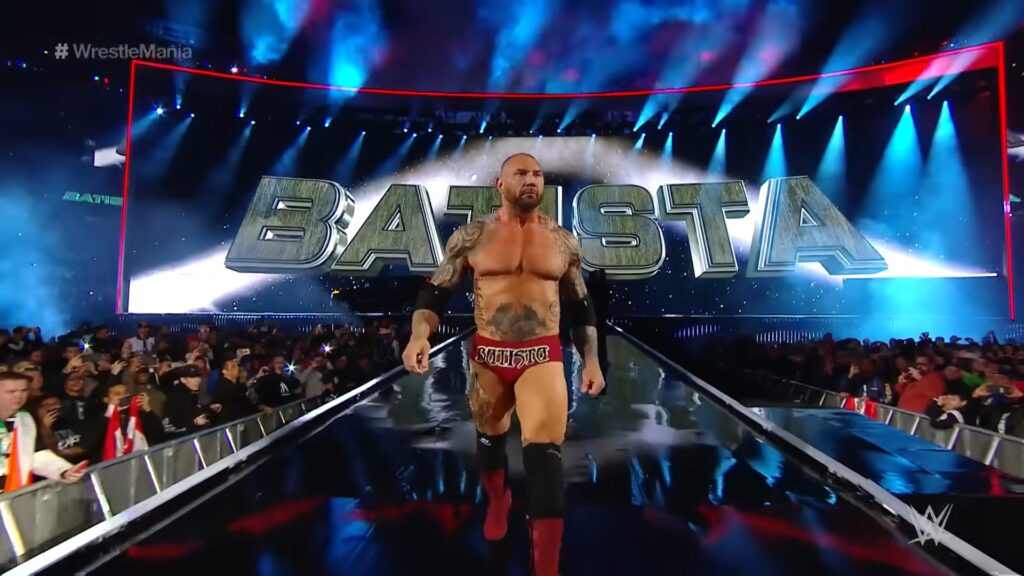
“Animal” is the equivalent of an upper bicep black tribal tattoo: intended to be badass, slightly generic, and very dated in 2025. Saliva’s lyrics and production elevated “Animal” to something specific to Batista and gave it some character. Add in Dave’s “squat double machine gun” pose, and you have a memeable entrance.
What? The Lyrics:
Josey remarked how it was different to write about someone else, as most of his lyrics were personal. “I Walk Alone” is about Batista setting out on his journey after the betrayal and break from Triple H’s stable, Evolution. But anyone who didn’t know that will think the song is about alienation, frustration, and burnination.
“This television has a poison on its breath / This counterculture of both wicked lives and death / It makes my eyes bleed every time I turn around / How will they all feel when I bring them to the ground?”
Of course, no one would really hear the lyrics after the WWE decided not to bore us and skip to the chorus, having Batista come out to the parts that everyone knows:
“I walk for miles inside this pit of danger / I’ve swallowed down a thousand years of anger / The weight of the world is fallin’ on my shoulders / A place where no one follows me / I walk alone.”
Indeed, he does. Batista is a man who doesn’t need allies or friends.
Does It Pass The 1-2-3 Second Rule?
Wrestler themes have roughly 1-3 seconds to convey who exactly is coming out—be it to hype up the crowd or inspire dread. WWE fans have to identify the entrant immediately, which is why many themes have soundbites at the start—from Seth Rollins’ “Burn It Down!” to Stone Cold’s shattering glass.
This feels like cheating because it is. A theme should stand on its own. And “I Walk Alone” does. Its opening guitar riff runs for about three seconds, right when everyone in the arena should be on their feet and looking to the entrance ramp.
Is This a Jim Johnston Jam?
Oh, you better believe it. J-J-J, all the way.
FINAL VERDICT
By now, you should get it: “I Walk Alone” doesn’t do it for me.
I checked out of modern rock and the WWE in the early 2000s. Blame the lack of cable and lack of interest. So I don’t have the nostalgia for that era’s rock or its wrestling.
But a lot of people do. And I get it. And to be fair, as a theme, “I Walk Alone” checks all the boxes: once that opening riff kicks in and Josey Scott’s scream leads you into the chorus, you know that “The Animal” is here.
But with this song by itself? You go on without me. I’m happy to walk in the opposite direction.
RATING: 3.75/5 BAH GAWDs.